

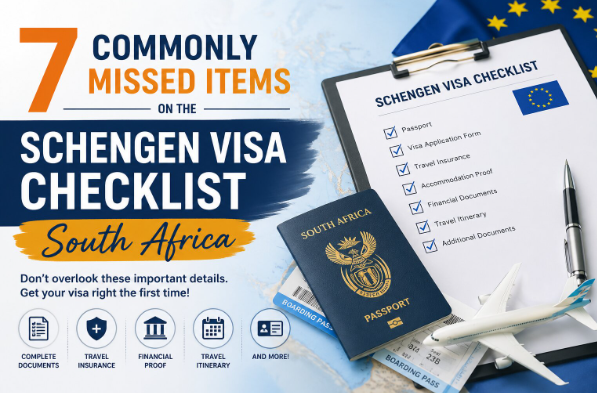
Planning a trip to Europe from South Africa can be exciting, but preparing your visa application is where many travellers start to feel overwhelmed. While most applicants remember their passport, application form, photographs, and proof of accommodation, there are several smaller details that can easily be overlooked.
A well-prepared schengen visa checklist south africa can help you avoid unnecessary delays and reduce the risk of submitting an incomplete application. Below are seven commonly missed items that South African travellers should pay attention to before submitting a Schengen visa application.
Key Takeaways
- Use the latest schengen visa checklist south africa requirements relevant to your destination and visa type.
- Check travel insurance, financial evidence, accommodation, employment documents, and your itinerary carefully.
- Make sure information across your application and supporting documents is consistent.
- A Police Clearance Certificate is not automatically required for every short-stay Schengen visa; provide one when specifically required.
- Start preparing early so you have enough time to obtain, translate, or update supporting documents.
1. Proof of Travel Medical Insurance
Travel insurance is not simply an optional extra for a Schengen visa application. Applicants generally need travel medical insurance that meets the requirements set by the Schengen authorities.
A common mistake is purchasing a policy without checking whether it provides the required geographical coverage, medical benefits, and validity for the entire Schengen area and intended trip.
Before submitting your application, check:
- The insurance covers the complete Schengen area.
- The policy covers the full duration of your planned stay.
- The required minimum medical coverage is included.
- Your name and travel dates are correctly shown on the certificate.
Keep a copy of the insurance certificate with your application documents.
2. Proof of Employment or Business Activities
Applicants often focus heavily on their travel arrangements and forget to demonstrate their circumstances in South Africa.
Evidence of your employment, business, or other legitimate commitments can help establish your circumstances and explain why you intend to return after your trip.
Depending on your situation, supporting documents may include an employment letter, recent payslips, approved leave confirmation, business registration documents, or other relevant evidence.
The important point is consistency. Your employment details, travel dates, financial information, and application form should tell the same story.
3. Recent Bank Statements and Financial Evidence
Having enough money for a European holiday is one thing; demonstrating your financial position properly is another.
Some applicants submit bank statements but overlook whether the statements cover the required period or whether the transactions reasonably support the information provided in the application.
Check your financial documents carefully. They should be clear, recent, and consistent with your stated income and travel plans.
If someone else is sponsoring your trip, additional supporting evidence may be required to explain the financial arrangement.
Avoid making unexplained large deposits immediately before applying, as unusual transactions may raise questions about the source of funds.
4. Proof of Accommodation for the Entire Trip
Your hotel booking for the first few nights may not be enough if your itinerary covers several destinations.
For example, if you plan to travel from France to Italy and then Germany, your accommodation evidence should correspond with your travel itinerary.
Check that:
- Every destination is accounted for.
- Your booking dates match your planned stay.
- The traveller’s name is correctly displayed where applicable.
- The accommodation details correspond with your application and itinerary.
If you are staying with family or friends, different supporting documents may apply, so check the requirements of the relevant consulate or visa centre.
5. A Clear and Consistent Travel Itinerary
An itinerary does not necessarily mean creating an hour-by-hour holiday schedule. However, your application should provide a logical explanation of where you plan to go, how long you will stay, and what your main travel purpose is.
One frequently overlooked issue is inconsistency between documents.
For instance, if your application says you will spend ten days in France but your hotel bookings and flight reservations suggest a different schedule, the discrepancy could create questions.
Review your:
- Flight reservations
- Hotel bookings
- Travel dates
- Destination information
- Leave dates
- Application form
Everything should align.
6. Correctly Prepared Supporting Documents
Applicants sometimes have the right documents but fail to check whether they have been prepared in the required format.
Depending on the consulate and your circumstances, documents may need to be translated, certified, copied, or presented in a specific way.
This is particularly important for documents that are not in an accepted language.
Before your appointment, check the latest requirements from the relevant Schengen country’s official visa authority or application centre. Requirements can vary depending on the country where you are applying and the purpose of your trip.
7. Previous Visa or Immigration Information
Another easily forgotten area is previous travel and immigration history.
If the application asks about previous visas, trips, residence permits, or immigration information, provide accurate details.
Do not assume that older travel information is irrelevant simply because the trip happened several years ago. Where the application specifically requests previous information, make sure your answers are complete and truthful.
It is also worth checking old passports if you have them, particularly if they contain previous visas or travel stamps relevant to your application.
Don’t Forget Your Police Clearance Documents When They Are Specifically Requested
Police clearance is an area that can cause confusion because a Police Clearance Certificate is not automatically required for every short-stay Schengen visa application.
Whether you need one depends on the specific visa circumstances and the requirements communicated by the relevant authority.
If you have been asked to provide a Police Clearance Certificate, make sure you have allowed enough time to obtain it.
Many applicants also wonder, how can i check my police clearance certificate status after submitting a request? The answer depends on how and where your PCC application was submitted. Check the official channel or service provider used for your application and keep your reference details available when making an enquiry.
The key lesson is simple: don’t add or remove documents based solely on general internet checklists. Always compare your documents with the current requirements for your specific Schengen destination and visa category.
Final Document Check Before Your Appointment
Before attending your visa appointment, take a few minutes to review the complete checklist from top to bottom.
Make sure your passport is valid, your application form is complete, your photographs meet the required specifications, and your supporting documents are organised in the requested order.
Most importantly, don’t leave the preparation until the last minute. If you discover that a document needs translation, certification, or additional processing, you may need extra time.
A carefully prepared application is not a guarantee of approval, but it can help prevent avoidable administrative problems.
Frequently Asked Questions
Q1. What documents are commonly required for a Schengen visa from South Africa?
Common requirements may include a valid passport, completed application form, photographs, travel medical insurance, proof of accommodation, travel arrangements, financial evidence, and documents demonstrating your circumstances in South Africa. Exact requirements depend on the destination country and visa type.
Q2. Is a Police Clearance Certificate required for a Schengen visa?
Not necessarily. A PCC is not a universal requirement for every short-stay Schengen visa applicant. If the relevant authority specifically requests one for your circumstances, you should provide it according to their instructions.
Q3. How early should I prepare my Schengen visa documents?
It is sensible to start well before your intended travel date. Some documents, such as police clearances, certified copies, translations, or appointments, can take additional time to arrange.
Q4. Can incorrect information affect my Schengen visa application?
Yes. Incomplete, inconsistent, or inaccurate information can create complications. Review your application and supporting documents carefully before submission and make sure your travel plans and personal information match throughout.
Q5. Does every Schengen country have exactly the same checklist?
No. Although Schengen countries follow common visa rules, individual consulates can have additional document requirements depending on your nationality, circumstances, purpose of travel, and destination. Always check the current requirements for the country responsible for your application.
